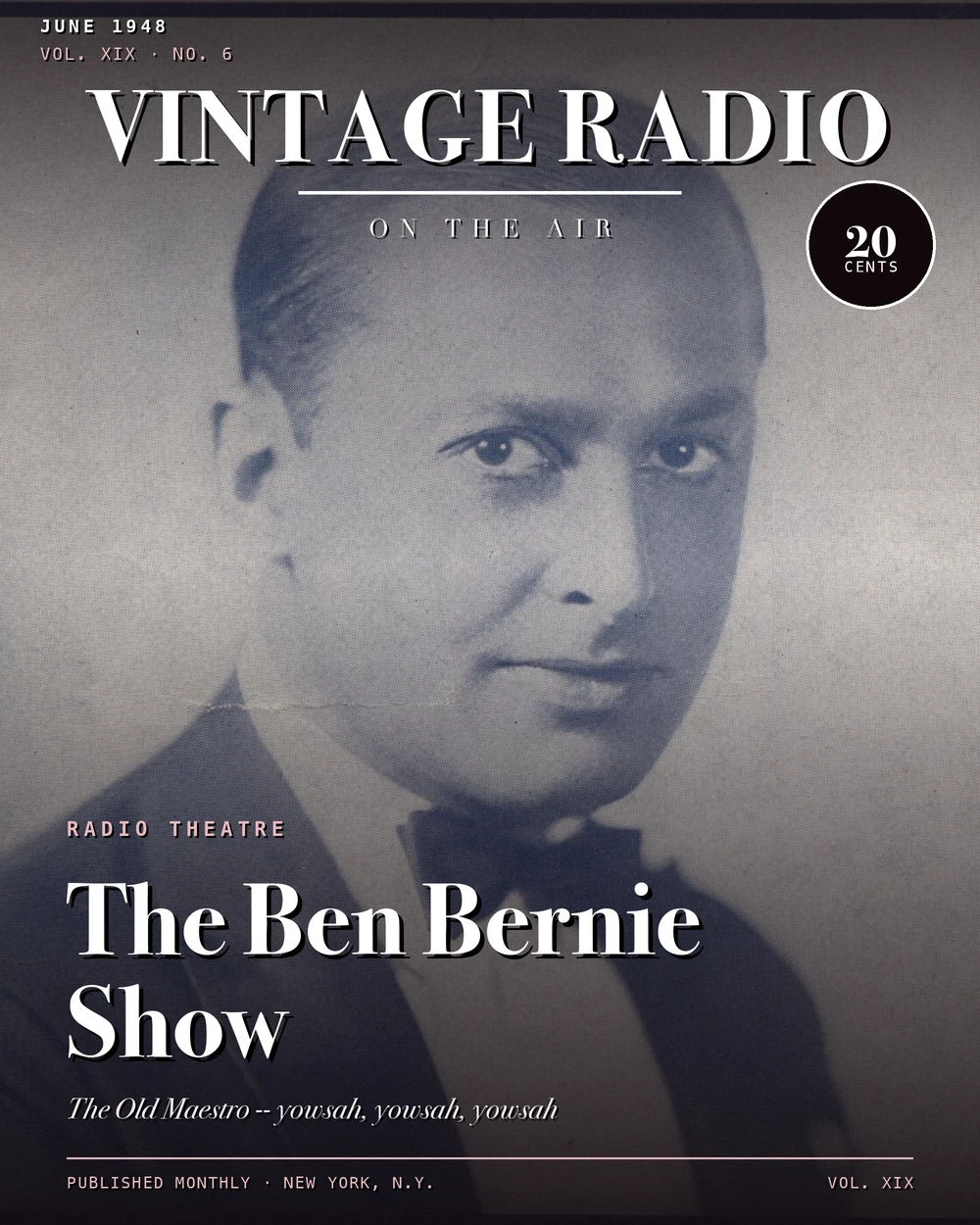
The Ben Bernie Show
The Old Maestro and His Lads
Ben Bernie was never really about the music. That was the joke, and also the point. As Current Biography put it in 1941, for Bernie "music is merely an interlude between snatches of talk" — the inverse of how most orchestra leaders ran their programs, where chat filled the gaps between numbers. Bernie flipped that arrangement deliberately, and the result was one of radio's longest-running Music programs, stretching from January 17, 1930 all the way to March 5, 1943, bouncing between WJZ, the Blue Network, CBS, and NBC as sponsors and formats shifted around him while the personality stayed constant.
His orchestra was billed on air as "All the Lads," and his full sign-off — "Au revoir a fond cheerio, a bit of toodle-oo, God bless you, and pleasant dreeeaaams" — became one of radio's most recognizable closing rituals. His opening theme was "It's a Lonesome Old Town," but by the time the closing theme "Au Revoir" rolled around, Bernie was already talking nonsense and fluff right over the music, giving his shows a loose, informal quality that felt less like a broadcast than an extended visit with someone who happened to have a band in the living room.
The Man Behind the Persona
Born Bernard Anzelevitz on May 30, 1891, in Bayonne, New Jersey, to Julius and Anna Anzelevitz — immigrants of Jewish descent, one of eleven children, his father running a horseshoeing establishment on South Street under the Brooklyn Bridge — Bernie came up the hard way through the New York entertainment world. His mother called him the "infant wonder of the violin," and he went on to study at Columbia University and the New York College of Music before debuting as a concert violinist at Carnegie Hall at roughly thirteen or fourteen years old. The concert-hall trajectory didn't hold. Vaudeville was more interesting.
He performed under the name "Ben, the Eccentric Violinist" after forming an act called "The Fiddle-Up Boys" with Charles Klass in 1912, then found more traction around 1915 partnering with accordionist Phil Baker. Baker gradually loaded more jokes into the act until what had started as a music routine was essentially comedy. That shift tells you everything about Bernie's instincts. In 1923, he landed his orchestra at the Hotel Roosevelt in New York City for what was supposed to be a brief engagement; they stayed as the house band through 1929. On November 15, 1926, Bernie and his orchestra were featured on the first NBC broadcast, via remote from that same hotel. In 1928, he starred in the Broadway musical Here's Howe, playing the character Dan Danny.
By the time he got to radio in 1930, Bernie had his persona fully formed: the smug, cigar-chomping, linguistically eccentric "Old Maestro" who clipped his g's and blended the sounds of Europe, Brooklyn, and the Old South into something Radio Stars described as a "smug air of assurance." His slang was dense enough that it came to be called the "Bible of Berniana," with "yowsah, yowsah, yowsah" as its cornerstone expression. His Depression-era catchphrase — "Come back, prosperity, all is forgiven!" — was still being quoted years after the Depression ended.
The Music, the Band, and the Borrowed Talent
Bernie played violin on air but was plainly not the musical engine of the operation. Baton duties fell to first violinist Mickey Garlock, who kept things running while Bernie did his talking. The ensemble churned through a remarkable amount of talent over the years — Oscar Levant on piano on his way to bigger things, trombonist Lou McGarity, saxophonist Dick Stabile, and a young Dinah Shore singing with the band before her own career took off. She appears in the roster of vocalists alongside Jane Pickens, Buddy Clark, Mary Small, Pat Kennedy, Scrappy Lambert, and Little Jackie Heller. Comics Lew Lehr and Fuzzy Knight provided additional texture. The announcing bench was equally well-stocked: Jimmy Wallington handled duties during the Pabst era, followed by Harlow Wilcox, Harry Von Zell, and Bob Brown.
The musical numbers themselves typically ran to light comedy. Around 1936, when Bernie performed "Mamma Makes Me Practice," he would talk the song into the microphone while Mickey Garlock scraped discordant notes on his fiddle beside him. He rarely timed his shows — his secretary Eleanor Smith told a reporter he preferred to judge time instinctively and fill with medleys at the end. The result was a sound of patchworked closings, the show always finding its way home somehow, even if the path was crooked.
In 1933, at the peak of the Pabst-sponsored NBC run, Bernie's show hit well into the top ten at 34 rating points. The Current Biography profile from 1941 described the broadcasts as reflecting "serenity and harmony, edged possibly by just a trace of condescension" — about as accurate a summary of the Bernie effect as anyone ever managed.
Sweet Georgia Brown and the Recording Career
Bernie's recorded legacy runs much longer than his radio career. The Discography of American Historical Recordings at UC Santa Barbara catalogs over 300 sessions from 1918 to 1943, cutting for Vocalion (1922–25), Brunswick (1925–33), Columbia (1933), Decca (1936), and ARC's Vocalion and OKeh labels (1939–40). In 1923, he and the Hotel Roosevelt Orchestra recorded "Who's Sorry Now?" But the recording that outlasted everything else was one made on March 19, 1925: the first recording of "Sweet Georgia Brown," which reached number one on the charts for five weeks.
The song is listed as a composition by Ben Bernie and Maceo Pinkard with lyrics by Kenneth Casey. The Syncopated Times has noted that Bernie was likely given co-composer credit as part of a common practice of the era, where bandleaders willing to record a song were sometimes rewarded with a songwriting credit, and that the actual composition was primarily Pinkard's work. Whatever the arrangement, Bernie's name stayed on the copyright. The Harlem Globetrotters eventually adopted a 1949 whistling-and-bones version by Brother Bones and His Shadows as their theme song in 1952 — and "Sweet Georgia Brown" has been associated with the team ever since. Bernie died in 1943 and never lived to see any of that.
His other original compositions included "Who's Your Little Whoosis?," "I Can't Believe It's True," "Holding My Honey's Hand," and "A Bowl of Chop Suey and Yooey." He joined ASCAP in 1934, working with collaborators including Kenneth Casey, Al Goering, Walter Hirsch, and Maceo Pinkard.
The Feud and the Films
No account of Bernie leaves out the Walter Winchell feud, and the reason is simple: it was extremely good radio, even if both men knew it was theater. Bernie would insult Winchell on air; Winchell would fire back on his own radio show and in his newspaper column. They'd both come from vaudeville — they understood the mechanics — and the exchange had no genuine acrimony behind it, operating on roughly the same principle as the Fred Allen–Jack Benny rivalry of the same era. A joint appearance at the Paramount Theater drew overflow crowds. Darryl F. Zanuck at 20th Century Fox recognized a commercial property and produced two films around the feud in 1937: Wake Up and Live, directed by Sidney Lanfield and co-starring Jack Haley and Alice Faye, and the follow-up Love and Hisses, with Simone Simon, Bert Lahr, and Joan Davis. Bernie and Winchell played themselves in both. Jack Haley's singing voice in Wake Up and Live was dubbed by Buddy Clark. Zanuck wanted to continue the series, but Winchell returned to New York to focus on his newspaper and radio work, and the film partnership ended.
Bernie and Winchell were also caricatured together in two Warner Bros. cartoons — The Coo-Coo Nut Grove (1936), where they appeared as "Ben Birdie" and "Walter Windpipe," and The Woods Are Full of Cuckoos (1937), where they turned up as "Ben Birdie" and "Walter Finchell." The feud itself ended when Bernie called a truce after Pearl Harbor, prompted by a woman in his audience who scolded him for continuing to take shots at Winchell after the attack. Bernie's other film appearances included Shoot the Works (1934), in which he played a bandleader named Joe Davis, and Stolen Harmony (1935), directed by Alfred L. Werker, in which he played a bandleader who recruits an ex-convict musician.
The End of the Run
The show's final configuration was its wartime one. From June 1941, with a long gap through the end of that year and into 1942, Bernie ran a fifteen-minute weekday program at 5:45 on CBS called "The Ben Bernie War Workers' Program," sponsored by Wrigley's Gum. Radio Life considered the short daily format well suited to his style — enough time for a number and some talk, not so much that the loose timing became a problem. Regulars on the wartime show included electric guitarist Les Paul, the King's Jesters vocal trio, and singers Jack Fulton, Russ Brown, and Gale Robbins. On February 1, 1943, Charlie Ruggles substituted when Bernie was sidelined with a pleurisy attack. By mid-January of that year, Bernie had already left the show to his cast. He died on October 23, 1943, and was buried at Mount Hebron Cemetery in Queens, New York.
In 1960, he was honored with a star on the Hollywood Walk of Fame at 6280 Hollywood Boulevard, in the radio category. The phrase "yowsah, yowsah, yowsah" continued to circulate through American pop culture long after his death — surfacing in the 1969 film They Shoot Horses, Don't They?, in a 1976 episode of Happy Days, in Chic's 1977 single "Dance, Dance, Dance (Yowsah, Yowsah, Yowsah)," and in Frank Zappa's 1979 "Dancin' Fool," among other places. Not a bad run for a catchphrase from a man who was, by the evidence, always more interested in the talk than the music anyway.